
80 Years Later, Utica University Returns to Where its Story Began
Eighty years ago, the grand lobby of Hotel Utica was filled with community leaders raising a glass to a new...

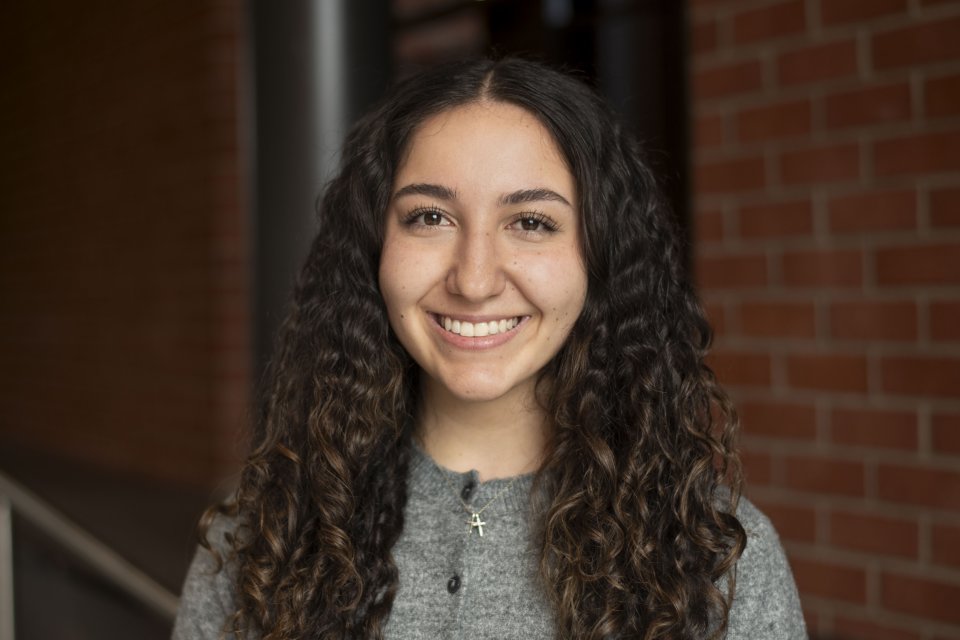
“These experiential opportunities allow students to understand how to apply their learning toward finding solutions to real problems."
Olivia D’Ambro ’26 began the physician assistant program at SUNY Upstate Medical University this summer.
Her undergraduate experience at Utica University helped her build the academic foundation and portfolio that earned her admission to her top-choice graduate program. And in the process, she gained much more than she ever anticipated – developing the confidence, skills, and perspective that will shape her future as a health care provider.
At Utica, she was drawn to the opportunity to contribute solutions to complex societal problems. Among the many opportunities she pursued, one of the most meaningful was her involvement with the Upstate Family Health Center.
She was assigned to the clinic – along with HLS 301 Introduction to Healthcare Advocacy and Navigation classmates John Durkin and Emma Thurber – to complete an eight-week experiential learning experience. The clinic provides care to a diverse patient population, including many individuals from refugee, immigrant, and low-income backgrounds. The students were asked to identify opportunities to improve the clinic’s health literacy efforts.
On her first day, D’Ambro arrived to find long lines stretching out the door. While shadowing different areas of the clinic, she noticed that the clinic’s online portal, intended to streamline appointments and reduce wait times, was seldom used by patients – especially by those for whom English was not a first language.
“It was shocking,” D’Ambro recalls. “Portals are so common in medical offices. For me personally, I always will use my online portal if I need to get in touch with my doctor.”
Beyond creating other efficiencies, Upstate Family Health Center, like most medical offices, designed the patient portal to reduce unnecessary in-person visits by allowing patients to complete routine tasks – such as requesting prescription refills or confirming appointment times – online, rather than traveling to the clinic.
However, D’Ambro estimated that roughly half of the patients waiting in those long lines did not have appointments and were unnecessarily waiting to see a physician, physician assistant, or nurse. She also discovered that translation services were unavailable in the registration area, creating an additional barrier for many non-native English-speaking patients.
Breaking the language barrier
Working closely with the office's clinical and non-clinical staff, the students collaborated to identify and develop practical solutions.
They first familiarized themselves with the clinic's online patient portal before developing a comprehensive outreach campaign to encourage its use. They created brightly colored, easy-to-follow pamphlets with step-by-step instructions for registering for and navigating the portal, along with an overview of its many benefits. The materials were translated into the five most commonly spoken languages among the clinic's patients and distributed throughout the waiting room, where a slideshow reinforced the information.
The students also presented their recommendations to clinic staff, demonstrating how these efforts could improve communication with patients, increase portal adoption, and enhance access to care.
For Mary Siniscarco, associate professor of health sciences, problem-based learning is the defining feature of Utica’s Health Sciences program and one of the qualities that sets the University apart. Rather than simply learning concepts in the classroom, students are immersed in real-world challenges that require them to draw on knowledge and skills from across the curriculum. The experience teaches them to think critically, collaborate effectively, and translate what they have learned into meaningful solutions for the kinds of complex problems they'll encounter in their careers.
“These experiential opportunities allow students to understand how to apply their learning toward finding solutions to real problems. It puts them into challenging, relevant situations,” Siniscarco says. “The assignments in our program are driven toward, ‘Here’s a problem in the health care society. Find a solution – evidence-base sourced.’”
Siniscarco says D’Ambro and her classmates played a pivotal role in the success of the project at Upstate Family Health Center.
“That particular assignment was very open ended. They really had to work with the team at Upstate to problem-solve and troubleshoot,” she says. “The students were the ones who took it to the next level.”
The Powerhouse
For D’Ambro, the experience further strengthened an already impressive graduate school portfolio. Beyond her coursework and field experiences, she worked as a patient care technician at St. Luke’s Rehabilitation Center and as a medical assistant at CNY Brain and Spine, a neurosurgery practice in New Hartford, gaining valuable hands-on clinical experience that complemented her classroom learning.
On campus, she helped create the Student-to-Student Educate Initiative, through which she and fellow members of the Health Sciences Student Society surveyed the student body and developed health and wellness-focused programs based on the topics students were most interested in. This past spring, she was selected to present the initiative at the University's Institute for the Study of Integrative Healthcare Conference, where her group was named best student presenters.
Through her involvement with the Health Sciences Student Society, she also volunteered with Sleep in Heavenly Peace, a local non-profit organization that builds and delivers handmade beds to children and families in need who do not have a proper place to sleep.
“I feel like all of these opportunities gave me so many important skills – leadership and problem-solving skills – and I think it just made me overall a more confident person and more confident in my career choice as a physician assistant,” D’Ambro says. “I spoke about all of these points in my graduate school interviews. It feel like it was the No. 1 thing that got me accepted into PA school.”
After completing physician assistant school, she hopes to pursue a career in primary care, ideally focusing on either cardiology or obstetrics and gynecology.
“She’s a powerhouse. We don’t create the powerhouse. We provide them the opportunity, and they decide to take it,” Siniscarco says. “She didn’t shy away from the challenge. Liv, not surprisingly, took it to the next level. She’s just such a hard-working, pedal-to-the-metal individual.”


For a general list of frequently used logins, you can also visit our logins page.