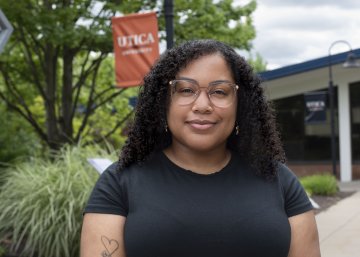
Daniela Muscari ’24, G’26 Accepted into Institute for Future Scientists in OT

The competitive honor is reserved for students who are interested in and have demonstrated a high aptitude for pursing a research-focused career in occupational therapy.
Through high school and entering college, Daniela Muscari ’24, G’26 was harboring a dilemma. She was drawn to the idea of working in a hospital setting and providing direct patient care. She enrolled in college with aspirations of becoming a physical therapist, but by grad school had gravitated toward occupational therapy.
All the while, the self-described “science and numbers girl” loved the precision and intricate detail of research work.
It was during her time at Utica University when Muscari discovered that not only were her two passions – providing care and advancing the field of medicine through research – not mutually exclusive, she also had in fact found the perfect place in which to fuse them.
“I never thought that I’d be able to do research. When I initially looked up OT as a possible career path, it seemed like, ‘Okay, I’ll be working in a school or a hospital, which (was wasn’t bad because) I knew I wanted to work in a hospital. So, I’d be going in, seeing my patients, writing my notes, and clocking out at the end of the day,’” she recalls. “I never thought I could take that further.
“And then in my classes,” she continues, “the professors started talking about research. I mean, they talked about it a lot. I felt kind of silly at first because I wasn’t making the connection.”
Silly but relieved – and, most of all, spurred into action.
Research was no longer the quiet interest that didn’t fit neatly with her career goals. It was now an intentional focus.
Last month, Muscari, now a second-year graduate student, was selected to participate in the Institute for Future Scientists in Occupational Therapy. The competitive honor is reserved for students who are interested in and have demonstrated a high aptitude for pursing a research-focused career in occupational therapy.
The Institute is a joint program of the American Occupational Therapy Association (AOTA) and the American Occupational Therapy Foundation (AOTF) that seeks to identify potential scientists, connect them with mentors in the occupational therapy scientific community, and develop a peer network. This year’s Institute will be held in April during the AOTA Annual Conference in Anaheim, CA.
“I can’t wait,” Muscari says. “I didn’t realize how competitive it was until I got accepted and called our program chair, Professor (Colleen) Sunderlin. She screamed, ‘Oh my god, that is huge!’
“I’m proud of myself for taking that step, and I love that people are seeing me as a researcher.”
Muscari’s long-term goal is to practice occupational therapy in an inpatient neurorehabilitation unit, while also developing evidence-based interventions to assist patients recovering from stroke or traumatic brain injuries. She’s hopeful that the Institute will propel, shape, and refine her research interests.
“I didn’t realize how competitive it was until I got accepted and called our program chair, Professor (Colleen) Sunderlin. She screamed, ‘Oh my god, that is huge!’"
“I’m really interested in neuropilates as an intervention for post-stroke rehab. It’s basically a workout plan for your brain. It’s the idea that if you move your body a certain way it’s reemphasizing that mind-muscle connection, and in stroke survivors it can help increase movement in the less functional limb if they keep repeating the same actions,” she says. “I’ve also looked into kinesiotaping post-stroke and the effect of blue light on the body’s circadian rhythm.”
In addition, she recently completed a research proposal for an idea she originally conceived back in high school and expanded on this year. The 12-month study, which Muscari, a high school and college lacrosse player, designed from scratch, involves the implementation and assessment of an afterschool lacrosse program that combines education and sport with emotional regulation interventions to help children who have experienced trauma.
“I’m excited for her,” says Sunderlin, professor and chair of occupational therapy. “Daniela is super driven about what she wants to do as she moves forward into the profession, and she is just such a passionate and dedicated person. She has the ability to be a fantastic researcher as well as an amazing practitioner.”
Muscari completed field work at Phelps Memorial Hospital in Sleepy Hollow, NY and is currently completing her second field work assignment at Jefferson Elementary School in Utica. She credits her research experience at Utica with giving her deeper insight into her patient’s diagnosis and recovery stage.
“Both (field work) settings I’ve been in have been amazing. When I’m at work, I’m so locked in. I try the best that I can to put myself exactly into their situation and know exactly what they’re feeling,” she says. “If my patient or client has this diagnosis, how are they feeling inside? What is difficult for them?”
Muscari says the emphasis Utica’s OT program places on applied research, presentation, and publication – as well as the support and guidance from professors and research advisors Yvonne Monti and Shannon Schoellig – have not only prepared her to be a proficient, patient-centered practitioner, but encouraged her natural tendency to explore, ask questions, and innovate.
“At the end of all of this, I’m an OT. I absolutely love what I do. I love helping patients. I also love reading articles and looking at p-values,” says Muscari, who is looking at Ph.D. programs centered around neuroscience, trauma informed care, or rehabilitative science. “It would be amazing to one day come up with a new intervention and be able to put it into practice or to create a new assessment tool and tap all these areas of OT that have never been tapped.
“I never thought that was possible. I thought it was just a dream in my head. Because we did so much research and there was such an emphasis, I now know that, ‘Okay, this can become a thing.’”